

Context first, Then you, Then impact.


At The Other Perspective, we work with a simple image. An hourglass. Context at the top, wide and open. You in the middle, the narrow point where everything comes together. Impact at the bottom, opening back out into the world.
Most coaching conversations skip straight to the middle. What do you want to achieve? What is holding you back? What is the plan? All good questions. But they miss something that determines whether any of it actually lands.
The context.
Why the room matters
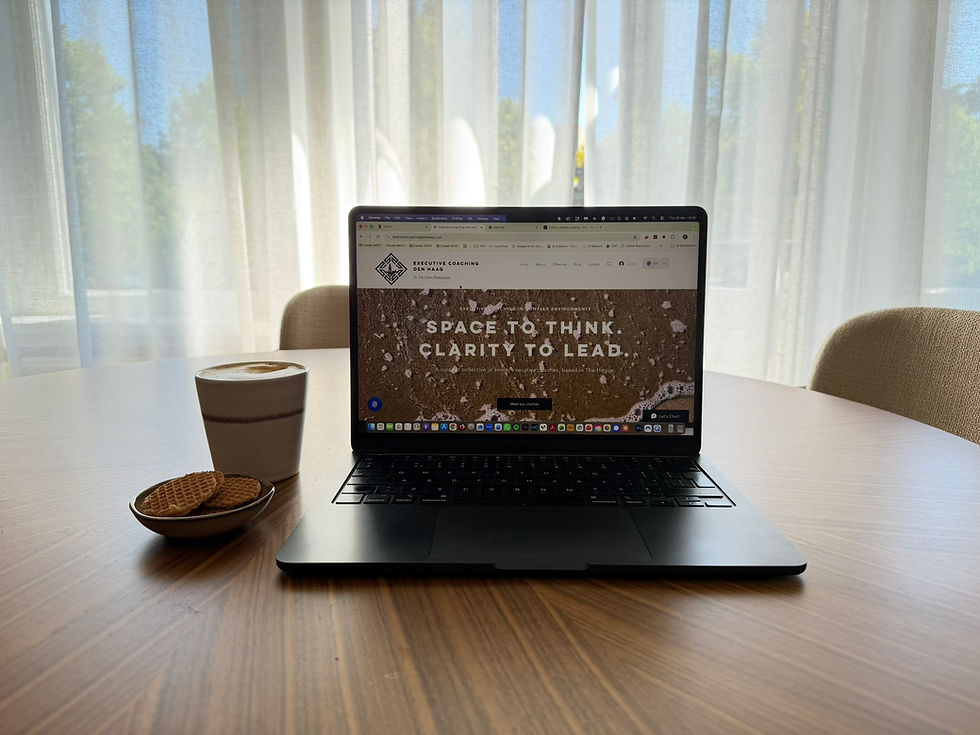
I moved my practice to Stories Den Haag not long ago. It was a small decision that turned out to matter more than I expected.
The light. The quiet. The fact that nobody is rushing to the next meeting the moment they walk in.
Executives spend their working lives in rooms designed for decisions, not reflection. Boardrooms, video calls, open offices. Very few of those rooms were built for a person to actually stop and think.
When the context changes, something in the person changes with it. Shoulders drop. The pace of speech slows down. People say things they were not planning to say, simply because there is finally room for it.
That is not a nice extra. It is the condition that makes the rest of the work possible.
What a good context creates
A good context does four things at once.
It creates rest. Not the absence of a challenge, but the absence of noise. A place where a leader can hear their own thinking again.
It creates space for personal attention. One person, fully seen, without competing for airtime the way they do everywhere else in their week.
It creates space to think. Not space to perform, or explain, or defend a decision already made. Actual room to work something out.
And because of all three, it creates effectiveness. The insight that would have taken months to surface in a rushed conversation shows up in an hour, because the conditions finally allow it.

Why the hourglass narrows before it opens
This is the part that is easy to miss. The narrow point in the middle is not a bottleneck to get through quickly. It is the point.
Everything that comes in through the context, the calm, the attention, the room to think, has to pass through the person before it can become anything real. You cannot skip from a good context straight to impact. The person in the middle has to actually use what the context gave them.
That is where the work happens. Quietly, in the narrow part of the hourglass, long before anyone can see the results.
Then it opens back up
Impact never stays with one person for long. A leader who has had the space to think clearly brings that clarity back into the room with their team. A decision made from rest instead of reflex changes how an entire organisation moves.
The widening at the bottom of the hourglass is not separate from the narrowing at the top. It is what the narrowing was for.
A different question to ask
Next time something is not landing, in a coaching relationship, a team, a difficult decision, it is worth asking a different question first. Not: what is wrong with the plan?
What is wrong with the room?
Curious what a different context could do for your leadership? You are welcome for a no-obligation introductory conversation.
Sonja Wekema is an executive coach and founder of Executive Coaching Den Haag. She works with Hogan Assessments, Insights Discovery, and Barrett Values methodologies.

Comments